Aspek Fisiologis Stres Panas pada Sapi Perah
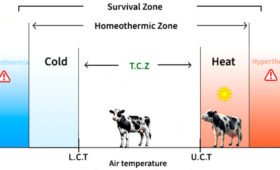
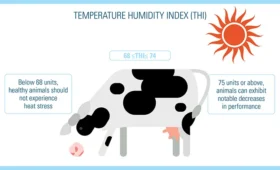
Stres panas pada sapi perah berpotensi mengurangi produksi susu, sekaligus berdampak signifikan pada reproduksi dan kesehatan. Menentukan titik di mana hewan mengalami stres termal sangat penting untuk mengoptimalkan manajemen fasilitas dan sistem pengkondisian termal, dan akibatnya, untuk keberhasilan sistem produksi. Untuk menentukan kondisi lingkungan termal hewan, indeks dan rentang termonetralitas berdasarkan variabel lingkungan telah dikembangkan, seperti Indeks Suhu dan Kelembapan (THI) [10].
Selama bertahun-tahun, ambang batas stres panas telah menurun karena perbaikan genetik, sehingga membutuhkan perhatian yang lebih besar pada sistem produksi untuk memastikan lingkungan yang nyaman bagi hewan. Saat ini, batas THI yang dapat diterima untuk sapi perah berproduksi tinggi (di atas 35 kg·hari−1) adalah hingga 68 [20]. Namun, karena THI didasarkan pada variabel lingkungan (suhu udara dan kelembapan relatif), persepsi stres pada tingkat hewan dapat terganggu. Alternatif untuk masalah ini adalah menggunakan hewan itu sendiri sebagai indikator stres. Beberapa pendekatan telah diadopsi di tingkat penelitian untuk mengukur dan membangun hubungan yang andal terkait timbulnya stres termal pada hewan [13,23,29]. Indikator hewan seperti laju pernapasan, suhu inti tubuh, dan penurunan produksi susu telah terbukti menjadi indikator yang andal untuk beban panas yang dirasakan oleh hewan [3,13]. Selain itu, penurunan produksi susu berfungsi sebagai indikator stres panas pada sapi [3,20]. Namun, penurunan produksi susu bukanlah respons instan, karena terdapat jeda antara timbulnya dan durasi stres termal dengan penurunan produksi yang diakibatkannya [20]. Oleh karena itu, indikator fisiologis hewan tampaknya menjadi penanda terbaik untuk menentukan momen stres. Variasi suhu tubuh dan laju pernapasan merupakan tanda pertama bahwa keadaan termonetralitas telah terganggu dan sapi mengalami stres termal [3].
Suhu tubuh hewan dapat diverifikasi melalui berbagai metode, termasuk pengukuran internal: suhu rektal, vagina, rumen, dan timpani, dan pengukuran eksternal: suhu permukaan, seperti termografi inframerah, seperti yang dilaporkan dalam berbagai penelitian [4,13,30]. Dalam sebuah penelitian dengan sapi Holstein laktasi yang ditempatkan selama empat hari di ruang iklim, dalam kondisi stres panas dengan THI bervariasi antara 74 dan 84 dan dalam kondisi termonetral dengan THI antara 55 dan 61, Garner et al. (2017) [30] mengamati bahwa suhu rektal dan vagina secara signifikan lebih tinggi pada sapi yang stres panas. Dalam perlakuan stres panas, nilai 40 °C dicatat untuk suhu rektal dan vagina, sedangkan dalam kondisi termonetral, nilainya adalah 38,5 °C untuk suhu rektal dan 38,8 °C untuk suhu vagina. Dalam studi yang sama, penulis mengamati perbedaan suhu permukaan ambing, mencatat 39,8 °C dan 35,2 °C untuk sapi yang ditempatkan dalam kondisi stres panas dan termoneutral, masing-masing. Efek variasi musiman pada suhu rektal pada sapi Holstein diamati oleh Rejeb dkk. (2016) [4] yang melakukan penelitian selama musim panas dan semi di Tunisia, menghitung THI rata-rata 83,3 untuk musim panas dan 65,6 untuk musim semi, dengan nilai suhu rektal 39,2 °C untuk musim panas dan 38,2 °C untuk musim semi.
Laju pernapasan merupakan indikator fisiologis yang efisien untuk menilai stres termal pada sapi perah. Mekanisme ini diaktifkan secara instan sebagai respons terhadap rangsangan stres panas, karena terengah-engah merupakan jalur yang sangat efisien untuk pembuangan panas tubuh laten. Dalam sebuah studi di Serbia, Vujanac dkk. (2010) [31] mengamati bahwa sapi-sapi produksi tinggi pada awal laktasi, dalam kondisi stres panas dengan THI di atas 70, menunjukkan laju pernapasan bervariasi dari 51,4 hingga 77,89 napas/menit sepanjang hari; sedangkan dalam kondisi non-stres panas, dengan THI di bawah 70, laju pernapasan berkisar antara 46,8 hingga 51,9 napas/menit. Hasil serupa diamati oleh Rejeb et al. (2016) [4], yang melaporkan laju pernapasan 79,4 napas/menit selama musim panas dengan THI 83,3 dan 43,9 napas/menit selama musim semi dengan THI 65,6. Ambang laju pernapasan yang dianggap nyaman adalah di bawah 60 napas/menit, dengan nilai antara 60 dan 80 napas/menit dicirikan sebagai indikator waspada dan di atas 80 menunjukkan kondisi berbahaya [13]. Pendinginan adalah alternatif yang layak untuk mengurangi stres termal pada sapi perah. Penelitian yang dilakukan di Israel menunjukkan bahwa sapi Holstein multipara dalam kondisi stres termal, dengan THI di atas 68, ketika didinginkan delapan kali sehari dengan sprinkler dan kipas angin, menunjukkan laju pernapasan 60,2 napas/menit, sementara yang didinginkan tiga kali sehari menunjukkan laju pernapasan 73,1 napas/menit [32], yang menekankan pentingnya metode pendinginan untuk sapi perah.
Stres panas pada sapi perah tidak hanya memengaruhi kesejahteraan fisik hewan, tetapi juga memiliki konsekuensi langsung terhadap produktivitas, kesehatan hewan dan mengoptimalkan produksi dan reproduksi.
Kami menjual alat kandang closed house dan melayani instalasinya serta pembangunan kandang sapi perah closed house.
Kesuksesan anda kebahagian kami
Hubungi kami +62 82333341149
References
- 1.Baêta F., Souza C. Ambiência Em Edificações Rurais. 2nd ed. Volume 1. Editora UFV; Viçosa, Brazil: 2010. [Google Scholar]
- 2.Chen S., Yong Y., Ju X. Effect of Heat Stress on Growth and Production Performance of Livestock and Poultry: Mechanism to Prevention. J. Therm. Biol. 2021;99:103019. doi: 10.1016/j.jtherbio.2021.103019. [DOI] [PubMed] [Google Scholar]
- 3.Hoffmann G., Herbut P., Pinto S., Heinicke J., Kuhla B., Amon T. Animal-Related, Non-Invasive Indicators for Determining Heat Stress in Dairy Cows. Biosyst. Eng. 2020;199:83–96. doi: 10.1016/j.biosystemseng.2019.10.017. [DOI] [Google Scholar]
- 4.Rejeb M., Sadraoui R., Najar T., M’rad M.B. A Complex Interrelationship between Rectal Temperature and Dairy Cows’ Performance under Heat Stress Conditions. Open J. Anim. Sci. 2016;6:24–30. doi: 10.4236/ojas.2016.61004. [DOI] [Google Scholar]
- 5.Damasceno F.A. Composat Barn Como Alternativa Para a Pecuária Leiteira. 1st ed. Volume 1 Gulliver; Osaka, Japan: 2020. [Google Scholar]
- 6.Becker C.A., Collier R.J., Stone A.E. Invited Review: Physiological and Behavioral Effects of Heat Stress in Dairy Cows. J. Dairy Sci. 2020;103:6751–6770. doi: 10.3168/jds.2019-17929. [DOI] [PubMed] [Google Scholar]
- 7.Burhans W.S., Rossiter Burhans C.A., Baumgard L.H. Invited Review: Lethal Heat Stress: The Putative Pathophysiology of a Deadly Disorder in Dairy Cattle. J. Dairy Sci. 2022;105:3716–3735. doi: 10.3168/jds.2021-21080. [DOI] [PubMed] [Google Scholar]
- 8.Polsky L., von Keyserlingk M.A.G. Invited Review: Effects of Heat Stress on Dairy Cattle Welfare. J. Dairy Sci. 2017;100:8645–8657. doi: 10.3168/jds.2017-12651. [DOI] [PubMed] [Google Scholar]
- 9.Roth Z. Reproductive Physiology and Endocrinology Responses of Cows Exposed to Environmental Heat Stress—Experiences from the Past and Lessons for the Present. Theriogenology. 2020;155:150–156. doi: 10.1016/j.theriogenology.2020.05.040. [DOI] [PubMed] [Google Scholar]
- 10.Thom E.C. The Discomfort Index. Weatherwise. 1959;12:57–61. doi: 10.1080/00431672.1959.9926960. [DOI] [Google Scholar]
- 11.Inadagbo O., Makowski G., Ahmed A.A., Daigle C. On Developing a Machine Learning-Based Approach for the Automatic Characterization of Behavioral Phenotypes for Dairy Cows Relevant to Thermotolerance. AgriEngineering. 2024;6:2656–2677. doi: 10.3390/agriengineering6030155. [DOI] [Google Scholar]
- 12.Brezov D., Hristov H., Dimov D., Alexiev K. Predicting the Rectal Temperature of Dairy Cows Using Infrared Thermography and Multimodal Machine Learning. Appl. Sci. 2023;13:11416. doi: 10.3390/app132011416. [DOI] [Google Scholar]
- 13.Pacheco V.M., Sousa R.V.d., Rodrigues A.V.d.S., Sardinha E.J.d.S., Martello L.S. Thermal Imaging Combined with Predictive Machine Learning Based Model for the Development of Thermal Stress Level Classifiers. Livest. Sci. 2020;241:104244. doi: 10.1016/j.livsci.2020.104244. [DOI] [Google Scholar]
- 14.Chung H., Li J., Kim Y., Van Os J.M.C., Brounts S.H., Choi C.Y. Using Implantable Biosensors and Wearable Scanners to Monitor Dairy Cattle’s Core Body Temperature in Real-Time. Comput. Electron. Agric. 2020;174:105453. doi: 10.1016/j.compag.2020.105453. [DOI] [Google Scholar]
- 15.Curtis S.E. Environmental Management in Animal Agriculture. Iowa State University Press; Ames, IA, USA: 1983. [Google Scholar]
- 16.Tinôco I.F.F. Avicultura Industrial: Novos Conceitos de Materiais, Concepções e Técnicas Construtivas Disponíveis Para Galpões Avícolas Brasileiros. Rev. Bras. Cienc. Avic. 2001;3:vti-717567. doi: 10.1590/S1516-635X2001000100001. [DOI] [Google Scholar]
- 17.Costa D.A.d., Santos V.M.d., Oliveira A.V.D.d., Souza C.L.d., Moreira G.R., Rosa B.L., Reis E.M.B., Queiroz A.M.d. Efeito Da Sazonalidade Sobre as Respostas Fisiológicas e Produtivas de Vacas Leiteiras Mestiças Ao Clima Amazônico Equatorial. Ciênc. Anim. Bras. 2023;24:e-73559E. doi: 10.1590/1809-6891v24e-73559p. [DOI] [Google Scholar]
- 18.Machado R.M.e.S., Bre F., Melo A.P., Lamberts R. The Impact of Climate Data Uncertainty on Bioclimatic Zoning for Building Design. Build. Environ. 2025;269:112423. doi: 10.1016/j.buildenv.2024.112423. [DOI] [Google Scholar]
- 19.Bewley J.M., Robertson L.M., Eckelkamp E.A. A 100-Year Review: Lactating Dairy Cattle Housing Management. J. Dairy Sci. 2017;100:10418–10431. doi: 10.3168/jds.2017-13251. [DOI] [PubMed] [Google Scholar]
- 20.Leso L., Barbari M., Lopes M.A., Damasceno F.A., Galama P., Taraba J.L., Kuipers A. Invited Review: Compost-Bedded Pack Barns for Dairy Cows. J. Dairy Sci. 2020;103:1072–1099. doi: 10.3168/jds.2019-16864. [DOI] [PubMed] [Google Scholar]
- 21.Ouellet V., Boucher A., Dahl G.E., Laporta J. Consequences of Maternal Heat Stress at Different Stages of Embryonic and Fetal Development on Dairy Cows’ Progeny. Anim. Front. 2021;11:48–56. doi: 10.1093/af/vfab059. [DOI] [PMC free article] [PubMed] [Google Scholar]
- 22.Campos P.H.R.F., Le Floc’h N., Noblet J., Renaudeau D. Physiological Responses of Growing Pigs to High Ambient Temperature and/or Inflammatory Challenges. Rev. Bras. Zootec. 2017;46:537–544. doi: 10.1590/s1806-92902017000600009. [DOI] [Google Scholar]
- 23.Lazzari J., Isola J.V.V., Szambelan V.L., Menegazzi G., Busanello M., Rovani M.T., Sarubbi J., Schmitt E., Ferreira R., Gonçalves P.B.D., et al. Thermoregulatory Response of Black or Red Lactating Holstein Cows in the Hot and Cold Season in Southern Brazil. J. Therm. Biol. 2024;121:103833. doi: 10.1016/j.jtherbio.2024.103833. [DOI] [PubMed] [Google Scholar]
- 24.Chen X., Shu H., Sun F., Yao J., Gu X. Impact of Heat Stress on Blood, Production, and Physiological Indicators in Heat-Tolerant and Heat-Sensitive Dairy Cows. Animals. 2023;13:2562. doi: 10.3390/ani13162562. [DOI] [PMC free article] [PubMed] [Google Scholar]
- 25.Casarotto L.T., Jones H.N., Chavatte-Palmer P., Laporta J., Peñagaricano F., Ouellet V., Bromfield J., Dahl G.E. Late-Gestation Heat Stress Alters Placental Structure and Function in Multiparous Dairy Cows. J. Dairy Sci. 2025;108:1125–1137. doi: 10.3168/jds.2024-25529. [DOI] [PubMed] [Google Scholar]
- 26.Renaudeau D., Collin A., Yahav S., de Basilio V., Gourdine J.L., Collier R.J. Adaptation to Hot Climate and Strategies to Alleviate Heat Stress in Livestock Production. Animal. 2012;6:707–728. doi: 10.1017/S1751731111002448. [DOI] [PubMed] [Google Scholar]
- 27.Zhou M., Groot Koerkamp P.W.G., Huynh T.T.T., Aarnink A.J.A. Evaporative Water Loss from Dairy Cows in Climate-Controlled Respiration Chambers. J. Dairy Sci. 2023;106:2035–2043. doi: 10.3168/jds.2022-22489. [DOI] [PubMed] [Google Scholar]
- 28.Zhou M., Huynh T.T.T., Groot Koerkamp P.W.G., van Dixhoorn I.D.E., Amon T., Aarnink A.J.A. Effects of Increasing Air Temperature on Skin and Respiration Heat Loss from Dairy Cows at Different Relative Humidity and Air Velocity Levels. J. Dairy Sci. 2022;105:7061–7078. doi: 10.3168/jds.2021-21683. [DOI] [PubMed] [Google Scholar]
- 29.Serviento A.M., He T., Ma X., Räisänen S.E., Niu M. Modeling the Effect of Ambient Temperature on Reticulorumen Temperature, and Drinking and Eating Behaviors of Late-Lactation Dairy Cows during Colder Seasons. Animal. 2024;18:101209. doi: 10.1016/j.animal.2024.101209. [DOI] [PubMed] [Google Scholar]
- 30.Garner J.B., Douglas M., Williams S.R.O., Wales W.J., Marett L.C., DiGiacomo K., Leury B.J., Hayes B.J. Responses of Dairy Cows to Short-Term Heat Stress in Controlled-Climate Chambers. Anim. Prod. Sci. 2017;57:1233. doi: 10.1071/AN16472. [DOI] [Google Scholar]
- 31.Vujanac I., Kirovski D., Bojkovski J., Prodanovic R., Savic B., Samanc H. Effect of Heat Stress on Vital Signs in High-Yield Dairy Cows. Vet. Glas. 2010;64:53–63. doi: 10.2298/VETGL1002053V. [DOI] [Google Scholar]
- 32.Pinto S., Hoffmann G., Ammon C., Amon B., Heuwieser W., Halachmi I., Banhazi T., Amon T. Influence of Barn Climate, Body Postures and Milk Yield on the Respiration Rate of Dairy Cows. Ann. Anim. Sci. 2019;19:469–481. doi: 10.2478/aoas-2019-0006. [DOI] [Google Scholar]
- 33.Gendelman M., Aroyo A., Yavin S., Roth Z. Seasonal Effects on Gene Expression, Cleavage Timing, and Developmental Competence of Bovine Preimplantation Embryos. Reproduction. 2010;140:73–82. doi: 10.1530/REP-10-0055. [DOI] [PubMed] [Google Scholar]
- 34.Wheelock J.B., Rhoads R.P., VanBaale M.J., Sanders S.R., Baumgard L.H. Effects of Heat Stress on Energetic Metabolism in Lactating Holstein Cows. J. Dairy Sci. 2010;93:644–655. doi: 10.3168/jds.2009-2295. [DOI] [PubMed] [Google Scholar]
- 35.Bernabucci U., Lacetera N., Baumgard L.H., Rhoads R.P., Ronchi B., Nardone A. Metabolic and Hormonal Acclimation to Heat Stress in Domesticated Ruminants. Animal. 2010;4:1167–1183. doi: 10.1017/S175173111000090X. [DOI] [PubMed] [Google Scholar]
- 36.von Keyserlingk M.A.G., Martin N.P., Kebreab E., Knowlton K.F., Grant R.J., Stephenson M., Sniffen C.J., Harner J.P., Wright A.D., Smith S.I. Invited Review: Sustainability of the US Dairy Industry. J. Dairy Sci. 2013;96:5405–5425. doi: 10.3168/jds.2012-6354. [DOI] [PubMed] [Google Scholar]
- 37.López-Gatius F. Is Fertility Declining in Dairy Cattle? Theriogenology. 2003;60:89–99. doi: 10.1016/S0093-691X(02)01359-6. [DOI] [PubMed] [Google Scholar]
- 38.Mendonça L.G.D., Mantelo F.M., Stevenson J.S. Fertility of Lactating Dairy Cows Treated with Gonadotropin-Releasing Hormone at AI, 5 Days after AI, or Both, during Summer Heat Stress. Theriogenology. 2017;91:9–16. doi: 10.1016/j.theriogenology.2016.11.032. [DOI] [PubMed] [Google Scholar]
- 39.Friedman E., Roth Z., Voet H., Lavon Y., Wolfenson D. Progesterone Supplementation Postinsemination Improves Fertility of Cooled Dairy Cows during the Summer. J. Dairy Sci. 2012;95:3092–3099. doi: 10.3168/jds.2011-5017. [DOI] [PubMed] [Google Scholar]
- 40.de la Sota R.L., Burke J.M., Risco C.A., Moreira F., DeLorenzo M.A., Thatcher W.W. Evaluation of Timed Insemination during Summer Heat Stress in Lactating Dairy Cattle. Theriogenology. 1998;49:761–770. doi: 10.1016/S0093-691X(98)00025-9. [DOI] [PubMed] [Google Scholar]
- 41.Brenu E.W., Staines D.R., Tajouri L., Huth T., Ashton K.J., Marshall-Gradisnik S.M. Heat Shock Proteins and Regulatory T Cells. Autoimmune Dis. 2013;2013:813256. doi: 10.1155/2013/813256. [DOI] [PMC free article] [PubMed] [Google Scholar]
- 42.Sanders A.H., Shearer J.K., De Vries A. Seasonal Incidence of Lameness and Risk Factors Associated with Thin Soles, White Line Disease, Ulcers, and Sole Punctures in Dairy Cattle. J. Dairy Sci. 2009;92:3165–3174. doi: 10.3168/jds.2008-1799. [DOI] [PubMed] [Google Scholar]
- 43.Pakrashi A., Ryan C., Guéret C., Berry D.P., Corcoran M., Keane M.T., Mac Namee B. Early Detection of Subclinical Mastitis in Lactating Dairy Cows Using Cow-Level Features. J. Dairy Sci. 2023;106:4978–4990. doi: 10.3168/jds.2022-22803. [DOI] [PubMed] [Google Scholar]
- 44.Rodríguez-Hernández P., Núñez-Sánchez N., Molina-Gay S., Rodríguez-Estévez V., Cardoso-Toset F. Near Infrared Spectroscopy Analysis as a Screening Tool to Classify Milk from Bovine Subclinical Mastitis and Promote Pathogen-Based Therapy. Appl. Food Res. 2025;5:100651. doi: 10.1016/j.afres.2024.100651. [DOI] [Google Scholar]
- 45.Spellman M.E., Geary C.M., Somula H., Singh A., Wieland M. The Association between Teat Shape and Clinical Mastitis. J. Dairy Sci. 2025;108:773–780. doi: 10.3168/jds.2024-25303. [DOI] [PubMed] [Google Scholar]
- 46.Sargeant J.M., Schukken Y.H., Leslie K.E. Ontario Bulk Milk Somatic Cell Count Reduction Program: Progress and Outlook. J. Dairy Sci. 1998;81:1545–1554. doi: 10.3168/jds.S0022-0302(98)75720-0. [DOI] [PubMed] [Google Scholar]
- 47.Buffington D.E., Collazo-Arocho A., Canton G.H., Pitt D., Thatcher W.W., Collier R.J. Black Globe-Humidity Index (BGHI) as Comfort Equation for Dairy Cows. Trans. ASAE. 1981;24:0711–0714. doi: 10.13031/2013.34325. [DOI] [Google Scholar]
- 48.Becker C.A., Aghalari A., Marufuzzaman M., Stone A.E. Predicting Dairy Cattle Heat Stress Using Machine Learning Techniques. J. Dairy Sci. 2021;104:501–524. doi: 10.3168/jds.2020-18653. [DOI] [PubMed] [Google Scholar]
- 49.Gorczyca M.T., Gebremedhin K.G. Ranking of Environmental Heat Stressors for Dairy Cows Using Machine Learning Algorithms. Comput. Electron. Agric. 2020;168:105124. doi: 10.1016/j.compag.2019.105124. [DOI] [Google Scholar]
- 50.Bovo M., Agrusti M., Benni S., Torreggiani D., Tassinari P. Random Forest Modelling of Milk Yield of Dairy Cows under Heat Stress Conditions. Animals. 2021;11:1305. doi: 10.3390/ani11051305. [DOI] [PMC free article] [PubMed] [Google Scholar]
- 51.Stygar A.H., Frondelius L., Berteselli G.V., Gómez Y., Canali E., Niemi J.K., Llonch P., Pastell M. Measuring Dairy Cow Welfare with Real-Time Sensor-Based Data and Farm Records: A Concept Study. Animal. 2023;17:101023. doi: 10.1016/j.animal.2023.101023. [DOI] [PubMed] [Google Scholar]
- 52.Li D., Yan G., Li F., Lin H., Jiao H., Han H., Liu W. Optimized Machine Learning Models for Predicting Core Body Temperature in Dairy Cows: Enhancing Accuracy and Interpretability for Practical Livestock Management. Animals. 2024;14:2724. doi: 10.3390/ani14182724. [DOI] [PMC free article] [PubMed] [Google Scholar]
- 53.Yan G., Zhao W., Wang C., Shi Z., Li H., Yu Z., Jiao H., Lin H. A Comparative Study of Machine Learning Models for Respiration Rate Prediction in Dairy Cows: Exploring Algorithms, Feature Engineering, and Model Interpretation. Biosyst. Eng. 2024;239:207–230. doi: 10.1016/j.biosystemseng.2024.01.010. [DOI] [Google Scholar]
- 54.Fuentes S., Gonzalez Viejo C., Cullen B., Tongson E., Chauhan S.S., Dunshea F.R. Artificial Intelligence Applied to a Robotic Dairy Farm to Model Milk Productivity and Quality Based on Cow Data and Daily Environmental Parameters. Sensors. 2020;20:2975. doi: 10.3390/s20102975. [DOI] [PMC free article] [PubMed] [Google Scholar]
- 55.Ji B., Banhazi T., Ghahramani A., Bowtell L., Wang C., Li B. Modelling of Heat Stress in a Robotic Dairy Farm. Part 2: Identifying the Specific Thresholds with Production Factors. Biosyst. Eng. 2020;199:43–57. doi: 10.1016/j.biosystemseng.2019.11.005. [DOI] [Google Scholar]
- 56.Géron A. Mãos à Obra: Aprendizado de Máquinas Com Scikit-Learn & TensorFlow. Alta Books; Los Angeles, CA, USA: 2019. [Google Scholar]
- 57.Obando Vega F.A., Montoya Ríos A.P., Osorio Saraz J.A., Andrade R.R., Damasceno F.A., Barbari M. CFD Study of a Tunnel-Ventilated Compost-Bedded Pack Barn Integrating an Evaporative Pad Cooling System. Animals. 2022;12:1776. doi: 10.3390/ani12141776. [DOI] [PMC free article] [PubMed] [Google Scholar]
- 58.Titto C.G., Negrão J.A., Titto E.A.L., Canaes T.d.S., Titto R.M., Pereira A.M.F. Effects of an Evaporative Cooling System on Plasma Cortisol, IGF-I, and Milk Production in Dairy Cows in a Tropical Environment. Int. J. Biometeorol. 2013;57:299–306. doi: 10.1007/s00484-012-0554-6. [DOI] [PubMed] [Google Scholar]
- 59.Zhang W., Yang R., Choi C.Y., Rong L., Zhang G., Wang K., Wang X. Recent Research and Development of Individual Precision Cooling Systems for Dairy Cows—A Review. Comput. Electron. Agric. 2024;225:109248. doi: 10.1016/j.compag.2024.109248. [DOI] [Google Scholar]
- 60.Liu E., Liu L., Zhang Z., Qu M., Xue F. An Automated Sprinkler Cooling System Effectively Alleviates Heat Stress in Dairy Cows. Animals. 2024;14:2586. doi: 10.3390/ani14172586. [DOI] [PMC free article] [PubMed] [Google Scholar]
- 61.Bertens C.A., Stoffel C., Crombie M.B., Vahmani P., Penner G.B. The Effects of Dietary Cation-Anion Difference and Dietary Buffer for Lactating Dairy Cattle under Mild Heat Stress with Night Cooling. J. Dairy Sci. 2024;107:10851–10868. doi: 10.3168/jds.2024-25225. [DOI] [PubMed] [Google Scholar]
- 62.Yang R., Zhang W., Choi C.Y., Rong L., Zhang G., Liu K., Wang X. Numerical Evaluation on Spray Cooling to Mitigate Heat Stress in Cattle Using Computational Fluid Dynamics. Comput. Electron. Agric. 2025;229:109775. doi: 10.1016/j.compag.2024.109775. [DOI] [Google Scholar]
- 63.Cao Z., Liu Y., Bai Y., Wang Y., Ye S., Cao H. Study on the Optimal Layout of Roof Vents and Rooftop Photovoltaic of the Industrial Workshop. Build. Environ. 2024;260:111624. doi: 10.1016/j.buildenv.2024.111624. [DOI] [Google Scholar]
- 64.Van Overbeke P., De Vogeleer G., Mendes L.B., Brusselman E., Demeyer P., Pieters J.G. Methodology for Airflow Rate Measurements in a Naturally Ventilated Mock-up Animal Building with Side and Ridge Vents. Build. Environ. 2016;105:153–163. doi: 10.1016/j.buildenv.2016.05.036. [DOI] [Google Scholar]
- 65.Andrade R.R., Tinôco I.d.F.F., Damasceno F.A., Ferraz G.A.e.S., Freitas L.C.d.S.R., Ferreira C.d.F.S., Barbari M., Baptista F.d.J.F., Coelho D.J.d.R. Spatial Distribution of Bed Variables, Animal Welfare Indicators, and Milk Production in a Closed Compost-Bedded Pack Barn with a Negative Tunnel Ventilation System. J. Therm. Biol. 2022;105:103111. doi: 10.1016/j.jtherbio.2021.103111. [DOI] [PubMed] [Google Scholar]
- 66.Oliveira C.E.A., Tinôco I.d.F.F., Damasceno F.A., Oliveira V.C.d., Ferraz G.A.e.S., Sousa F.C.d., Andrade R.R., Barbari M. Mapping of the Thermal Microenvironment for Dairy Cows in an Open Compost-Bedded Pack Barn System with Positive-Pressure Ventilation. Animals. 2022;12:2055. doi: 10.3390/ani12162055. [DOI] [PMC free article] [PubMed] [Google Scholar]
- 67.Liao C.-M., Chiu K.-H. Wind Tunnel Modeling the System Performance of Alternative Evaporative Cooling Pads in Taiwan Region. Build. Environ. 2002;37:177–187. doi: 10.1016/S0360-1323(00)00098-6. [DOI] [Google Scholar]
- 68.Tresoldi G., Schütz K.E., Tucker C.B. Cooling Cows with Sprinklers: Effects of Soaker Flow Rate and Timing on Behavioral and Physiological Responses to Heat Load and Production. J. Dairy Sci. 2019;102:528–538. doi: 10.3168/jds.2018-14962. [DOI] [PubMed] [Google Scholar]
- 69.Dikmen S., Larson C.C., De Vries A., Hansen P.J. Effectiveness of Tunnel Ventilation as Dairy Cow Housing in Hot Climates: Rectal Temperatures during Heat Stress and Seasonal Variation in Milk Yield. Trop. Anim. Health Prod. 2020;52:2687–2693. doi: 10.1007/s11250-020-02309-3. [DOI] [PubMed] [Google Scholar]
- 70.Chen J.M., Schütz K.E., Tucker C.B. Cooling Cows Efficiently with Water Spray: Behavioral, Physiological, and Production Responses to Sprinklers at the Feed Bunk. J. Dairy Sci. 2016;99:4607–4618. doi: 10.3168/jds.2015-10714. [DOI] [PubMed] [Google Scholar]